


About seventy years apart, two scientists were invited to Sweden. “An important fraction of United States industry adheres to the idea that research of a fundamental character is worthwhile from a practical point of view,” William Shockley said from the podium during his Nobel lecture, Transistor Technology Evokes New Physics. Asked minutes after learning he had won the Nobel on whether it mattered that AlphaFold had come from a company rather than a university, Demis Hassabis replied, “I don’t think so. I feel like you can do great science anywhere as long as you’re approaching it in the right way.”
There’s a difference. For Shockley, corporate science is water. Everyone’s swimming in it and everyone knows everyone’s swimming in it. For Hassabis, or more accurately his interviewer, corporate science is an exception.
If corporate science were judged solely by its fruits during those seventy years, it would seem strange to ask the question. Corporate science gave us the math of communication, the relic radiation of the Big Bang, the microscope that sees single atoms, coherent light, the math of rough shapes, the first synthetic fiber...
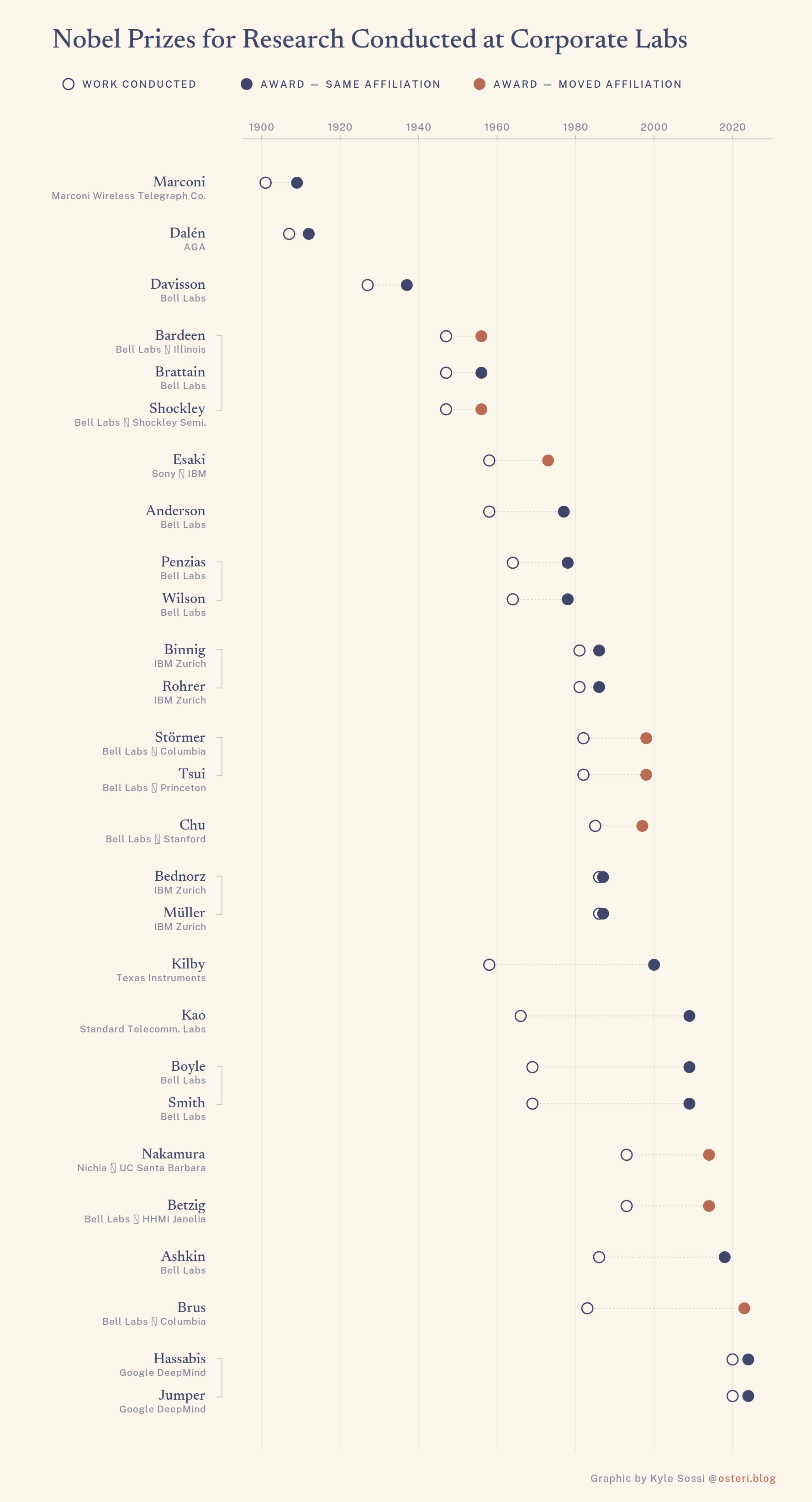
Besides discoveries, the question of how to organize corporate science and its workers has diffused into unexpected places. Lab directors were on the frontier of how to manage knowledge workers, though they didn’t call them that yet. The dual technical-and-managerial career track that let researchers advance without becoming people-managers, what we now call the Individual Contributor, was formalized at IBM in 1962. The campus-style corporate headquarters with their famous commissioned architects. The practice of giving employees non-accountable time for side projects, whether formalized or informally tolerated as bootlegging.

So where does the suspicion come from?
Maybe it comes from broken promises between what corporate employers offered those idealistic scientists and what they received?
In 1927, Du Pont tried to steal the chemist Louis Fieser away from Bryn Mawr. Fieser went kicking and screaming: “I never expected to go into industrial work but the thing which makes a decision so difficult in this case is that I don’t have to sell my soul at all; they even said I could bring my quinones along and continue my present work” (quoted in Shapin, 2008).
John Hopfield sweated over where he would fit in the 1950s job market: “Academia or industry? The answer was clear from the Solid State Seminar speakers I had heard. AT&T’s Bell Labs (Murray Hill) and General Electric (Schenectady) had broader, more vigorous research programs in solid state physics than any university did.”
Some managed to keep a foot in both camps. Like Boaz Barak, who splits time between Harvard and OpenAI. “I’m now also very interested in having an actual impact on AI as it will affect people’s lives, and being at OpenAI is a good place to do it.” He added that Harvard’s compute resources, though extensive, weren’t comparable to what industry could provide.
For Venkatesh Narayanamurti, a 20-year veteran of Bell Labs, if a prospective hire shared that they wanted to continue their thesis work once they got hired it was actually a countersignal, as it meant the researcher wasn’t thinking big enough. His researchers never had to write reports for him, either, because he was always there and knew what they were working on. Sounds intolerable.
This sentiment is similar to the view of others at Bell through its history: the problems of the firm are interesting scientific problems and researchers naturally gravitate to interesting problems.

I now invite you to waste an hour exploring the work of Benoit Mandelbrot, who felt that his research could only have been done outside the university: “Some today argue that my kind of science belongs in a public university, not a corporate laboratory. In fact, none of my discoveries could have been done in the formal atmosphere of a university.”
Ok, in some cases they did have academic freedom on par with, possibly surpassing, their academic peers. Not every corporate lab was trying, though. A Monsanto training film from the mid-century depicted laboratory workers in a corridor while a narrator remarked, “No geniuses here; just a bunch of average Americans working together” (quoted in Shapin, 2008). I wonder if those average Americans got a look at this script on filming day.
But surely financial pressures were ever-present, the crushing logic of the market weighing down on the caught-in-the-clouds heads of these researchers?
In 1912, George Eastman asked Kenneth Mees to build him a photographic research laboratory at Kodak. Mees told his new boss that commercially useful results were not to be expected for ten years. Eastman wrote the check.
Striking a similarly conciliatory tone in his demands was Charles “Boss” Kettering, who ran General Motors Research from 1920 to 1947: “I would never be accountable for the money I spent... You can’t keep books on research, because you don’t know when you are going to get anything out of it or what it is going to be worth when you get it” (quoted in Shapin, 2008).
This may have been the view from the corner office, but was it felt by the researchers? Henry Pollak, a researcher at Bell, remarked: “there was the philosophy: look, what you’re doing might not be important for 10 years or 20 years, but that’s fine, we’ll be there then.”
Today, Alphabet has the same arrangement. The Other Bets segment, including Waymo, Verily, Wing, Calico, Intrinsic, and others, has collectively burned billions on long-horizon work that the search-advertising business covers each quarter, and the shareholders are told so in plain language.
Is this frivolous spending or portfolio logic applied to corporate exploration? Place many bets anticipating that one will pay off enormously. We associate this logic with VCs, but “Boss” got to it first: “We take a chance on spending so much for research in the hope that the boys may stumble onto something and we may make a little money out of it” (quoted in Shapin, 2008).
“Management is challenged to put aside its own technical judgments and assessments and prejudices and just bet on the people” could have come from A16Z or Peter Lee, former head of Microsoft Research.
Another complication: it turns out, maintaining academic norms against financial pressures is a two-way street. That same Lee once feared that “all of our researchers are perhaps too devoted to helping Microsoft win in the market today.” Mees observed the same nearly a century before about researchers in Kodak’s industrial laboratory: “[they] naturally want to engage in work which will result in direct and visible financial gain, and hesitate to carry on fundamental work for which no commercial application can be seen” (quoted in Shapin, 2008). Researchers may still internalize the logic of the firm at the organization-level, even when the promise at the unit-level is freedom and curiosity.
Let’s grant then that some pockets of corporate science had academic freedom and financial cushion. But they didn’t share science’s ideals of communalism, right?
Here comes “Boss” once again. “When you lock the laboratory door, you lock out more than you lock in” (quoted in Shapin, 2008).
Ralph Bown, Bell’s vice-president through the transistor era, was desperate to keep a lid on the lab’s secrets: “Prompt scientific publication is a sound policy for any research enterprise to follow as much as it can… No one laboratory has more than a fraction of the talent that can operate usefully on a new scientific idea” (quoted in Shapin, 2008).
Also playing close to the vest, was Kodak’s Mees: “[Mees] felt that publication of much of the work would enlarge the knowledge basis of the subject, and even though it might help his competitors in business the resulting advance in the field as a whole could not fail to benefit his Company and science.”
Despite valid objections to field narrowing and transparency on methods, almost any modern AI conference is dominated by submissions from corporate labs. In 2022, DeepMind was responsible for 12% of the most-cited AI papers globally, with only Meta and Google proper producing higher impact. 67% of the top 100 most cited AI research papers were from corporate sources that year.
On being one of the good eggs, Yann LeCun said “[Meta FAIR] caused other labs like Google to become more open, and other labs to also kind of publish much more systematically than before.”
Economists have names for this. Nelson: a diversified monopolist can be an exception to firms underinvesting in basic research, because it can internalize its own spillovers. Rosenberg: publishing is a sort of admission ticket to the information network. Stern: scientists pay to be scientists, trading wages for the right to publish and freedom to pursue interesting questions. Which explains the cascade LeCun describes. One actor offering wages plus freedom reprices all the other researchers in the system.
So why do we still call it corporate science?
Part of the answer is that we’re suspicious of knowledge claims made by people with financial interests in them. Tobacco companies funding cancer research. Oil companies funding climate science. Pharmaceutical companies funding trials of their own drugs. Startups talking their own book. We’re all familiar with these examples.
But these are heuristics and “corrupted science” isn’t an exclusive pathology of corporates. It’s institutional and rears its head wherever the incentives are aligned. Academic careers reward publications, citations, and novelty, giving us p-hacking, salami slicing, and replication crises. Firms reward commercial success, giving us secrecy, hype, and conflicts of interest.
We tend to judge academic science by its ideals and corporate science by its perversions.
Those incentives may be more visible in industry, but the voices of these scientists show that norms can hold quite radically. Norms that were received through their training, acculturation into the world of science, and upheld when management reproduced the conditions where scientists could recognize one another as scientists.
As Hassabis said, doing science here is only a question of doing it in the right way.
Then what does doing it in the right way mean?
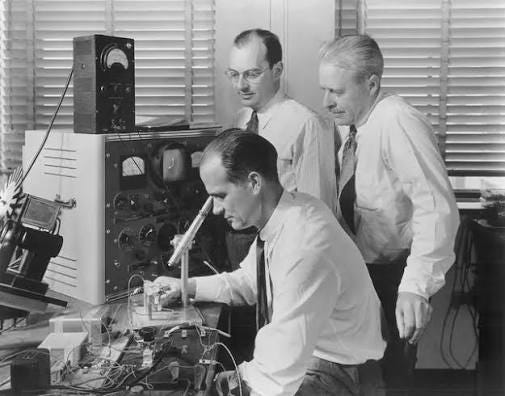
Let’s end where we began, with Shockley. To understate, Shockley was a difficult person. One of the milder anecdotes about his management style was submitting his staff to a lie detector test after allegations of sabotage, and those familiar with the history of Silicon Valley will be aware of the “Traitorous Eight.” His name, not theirs.
This paranoid style was not newfound at Shockley Semiconductor; it was unconstrained there. His competitiveness, jealousy over credit, and certainty that he was right at the expense of other leads were all present at Bell. But his faults could be absorbed so long as his authority was bounded, and Bell built institutional scaffolding around him.
Bell intervened relentlessly on the institution and surprisingly little on ideas.
Take the patent: Shockley wanted the transistor patent written around his own field-effect concept, which Bell’s attorneys disputed due to prior art, filing on Bardeen and Brattain’s device instead. When he absconded to a hotel room to work out the junction transistor and froze his colleagues out of the follow-on work, their appeals to their boss’s boss worked, and Brattain was moved out from under him. And he was locked out of the executive track throughout his time at Bell, because they judged scientific and managerial competence separately.
Not paradise, but workable.
All of this was run back at his own firm sans scaffolding. Senior staff appealed to his backer Arnold Beckman to move Shockley out of management; Beckman backed his founder, and the eight walked. He bet the company on the four-layer diode at the expense of anything else. Even though he was right on the science (it anticipated the thyristor), he was wrong on the market and the manufacturing.
Nothing at his shop could unleash what made Shockley a genius, and constrain what made him difficult.
That’s the rub.
The freedom to work on anything happened within a context designed so that “anything” collided with the problems of the firm. Financial logic wasn’t suspended, it was a bet, and the bet was extended on trust to “the boys” that they might stumble onto something. Publications were free, so long as the patent attorneys got a first look.
And Shockley has the freedom to be Shockley, so long as being Shockley doesn’t get in the way of the other geniuses.
This post was brought to you by Laurie Spiegel’s The Expanding Universe, composed at Bell Labs.