


Research institutions are complex systems made up of interactions between funding, governance, people, strategy, and accumulated know-how. When we write about them, we can make those interactions feel more orderly than they are.
Osteri Labs is a place for short, playable models that make these systems easier to explore. They’re made for teams or individuals who are creating research institutions or want an on-theme way to do some team building.
The first simulation is called Build a Tool That Travels. In it, you found an institution, make some important decisions, and see whether you can complete your mission on time.
The underlying game engine includes some randomness. Well designed institutions can still struggle and questionable ones can get lucky. The intention is to provoke discussion between people and surface common or orthogonal ways of thinking about the same problem.
You can access it at labs.osteri.blog. If you want to use it for a group activity, there’s also a downloadable facilitator’s guide with info on how it works, how to structure the activity, and some leading questions to get people talking.
I’m planning to build more missions in this series and some visual explorables (like you’d find here). If you have ideas or feedback, please reach out by commenting or sending me an email at kyle@osteri.blog.
The simulator
Working title for this series is “Trade-offs, Events, and Trajectories: Research Institution Simulator.” You can call it T.E.T.R.I.S. for short.
You’ll set up an initial design for an institution, making choices about how patient your funding is, how concentrated it is in one or many sources, how closely coupled you are to end-users during development, and more.
These choices impact the probabilities of project success during the run and the likelihood that certain decision points will come about. You had some early success and your founder (which is you) was noticed? Congrats! You now have to decide whether to stay with the institution or leave for the new job and let the existing governance play out. This can impact the game differently depending on how you initially configured your project governance.
Here’s what a run looks like.
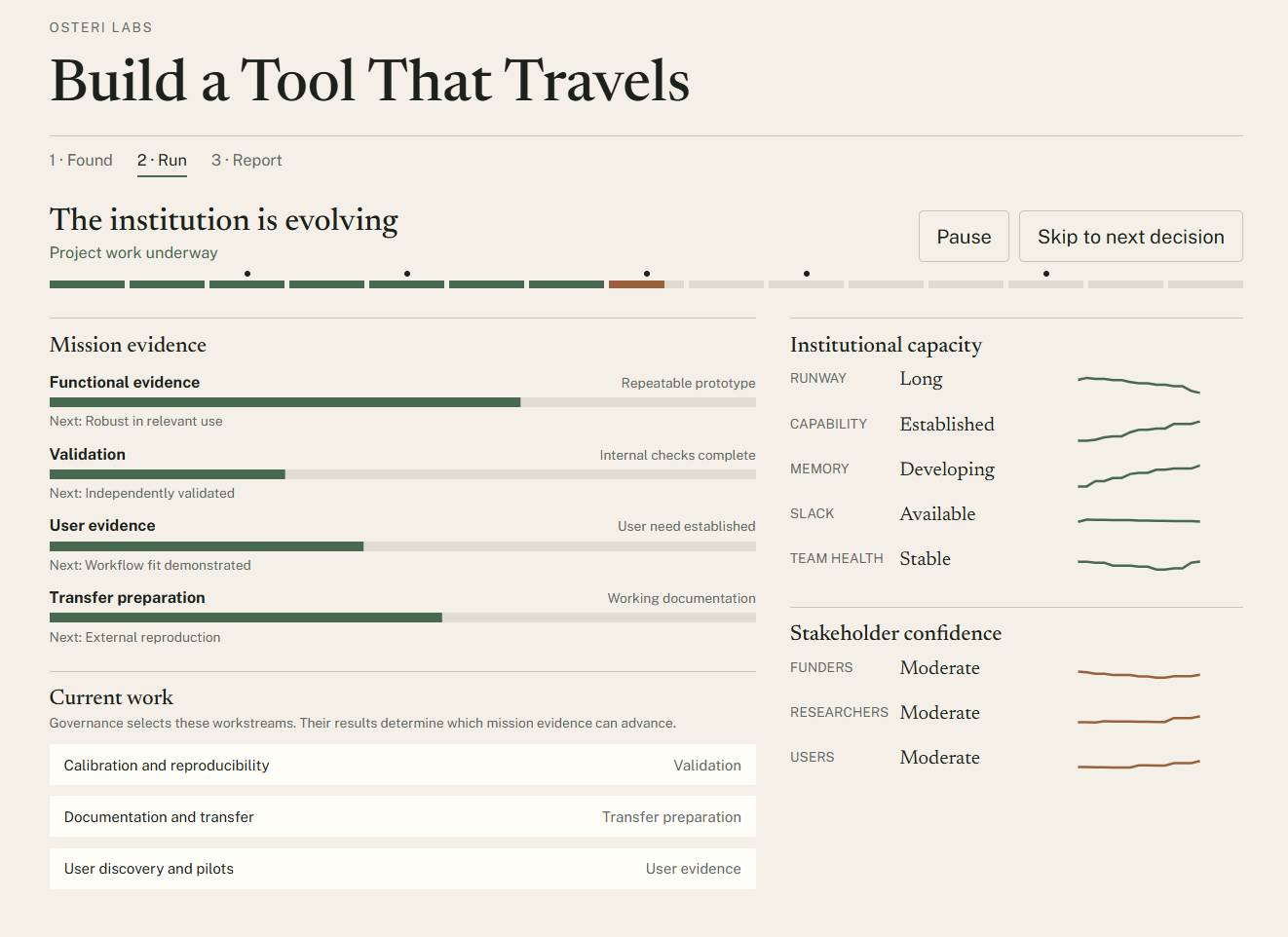
Some strategies work better than others, but most can be successful
There are three main outcomes from the simulation, you can complete the mission (either by the end of the run or before schedule), reach the end of the cycle without fully completing the mission but having some transferable output or likelihood of continued existence, or run into financial failure.
Here’s the distribution of several institution archetypes across 10,000 seeded runs.
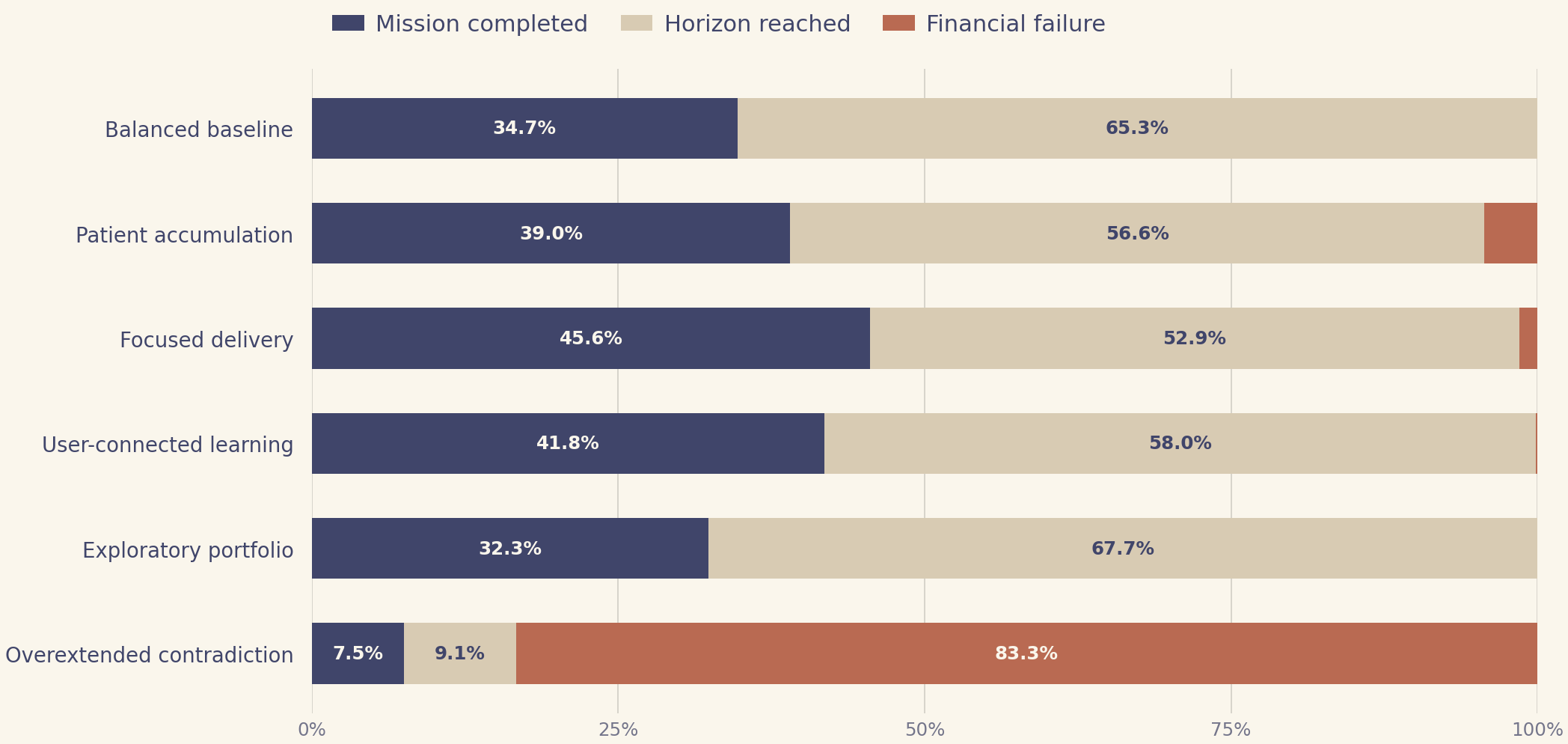
Focused delivery completed the mission most often, but other strategies were successful too. Exploratory portfolios tended to be less likely to finish, but also didn’t run into financial failure.
These aren’t meant to be empirical judgements about which institutions are best. The intent is to create plausible scenarios with plausible win percentages that allow teams to think through trade-offs and strategies.
Inspiration
There was a great piece recently in Analogue Press, which you can read below. It’s an inventory of the different characteristics an R&D organization can have.
In it, they made a provocative claim that based on the particular configurations of these traits, there are 210 potential distinct types of organizations. Which is mind-blowing. I think the actual number is much smaller than that, but that the design space is also larger than the current types we have.
Navigating this space is a challenge and I thought simulations could be a fun way for people to do it.