


You are sitting in a group on the steppe 2 million years ago. If someone squinted hard while driving past in a car, the least hairy of you might look vaguely human. You grab a rock, look at it for a moment, and slam it down on another rock. In doing so, the rock shears. Rock is now sharp. As far as this group knows, you just invented technology. Congrats.
Everyone around you starts doing the same. Picking rocks up, slamming them against other rocks to create sharper, sub-rocks. All but one of you. They stare at the rock to sub-rock shearing spectacle wondering: “How could this be? How could such a rock-to-sub-rock shearing spectacle possibly be?” They stare and stare. They stare for a long time, long after you and the group have started using the rocks to shave sticks into points for the next hunt and, upon returning, use them again to remove the animals’ hides.
After a long time the watcher starts to jump up and down! They know why rock became sub-rock. It comes to them in a single moment of perfect clarity. Kinetic energy from the slamming motion became elastic deformation. Stress concentrated at the tips of tiny cracks in the rock. When
the cracks propagated and the rock fractured! As far as this group knows, the first eureka.
Stunned with this new knowledge and its limitless potential applications for rock slamming and sub-rock creation, they run over to you, grab you by the shoulders, stare deep into your eyes, and say “ooga booga.”
This is the relationship between science and technology. Craft, practice, and tools create phenomena that provoke a desire for explanation, or open new ways of investigating the world. Those explanations suggest future technologies or further explanations. Advancement is entangled and contingent. Sub-rocks shape sticks and combine to form axes to chop down trees to melt rocks into metals to build engines attached to presses of sharpened melted rocks to fashion new axes. Brian Arthur calls this process combinatorial evolution. The tech tree branches onwards and outwards, yet we only explore some of its paths. Eventually, your group on the steppe might find some use for the conceptual, rather than tacit, understanding of elastic deformation. First, you’ll have to invent language.
It’s wrong, then, to believe the linear model is an accurate story of innovation, and yet it’s wrong-er to believe the idea began with The Endless Frontier, to ignore the utility of a seemingly silly notion, or to forget that its defense is often bundled with a status claim.
“We wish for something higher and nobler in this country of mediocrity, for a mountain to relieve the landscape of its monotony.”
Henry Rowland, A Plea for Pure Science, 1883
If we were asked to start from scratch and inject dollars into the entangled morass called innovation, we may again find it simply easier if every actor is assigned a role. The scientist discovers. The engineer applies. Businesses develop. Markets receive. Schoolhouse Rock’s “How an Idea Becomes an Innovation.” Where do you even exert leverage in the chain-link model?
And we may find it easier to create heroic sub-plots within that story. Status can go to the idea-haver; everyone downstream is progressively more sullied. Direction is implied… the idea must be heading somewhere. If, as reality bleeds into the dream, the natural journey is interrupted, something else must be responsible: the market, the user, the realities of cost. A roadblock. A gap. A valley filled with death.
Perhaps we find these valleys when science is placed on a mountain.
The first survey of the valley
Yet I overhear the Whispers and Doubts of many, who demand, what they have done all this while? And what they have produc’d, that is answerable to these mighty Hopes, which we indeavour to make the World conceive of their Undertaking?
Thomas Sprat, The History of the Royal Society of London, 1667
It’s funny how much of Science was there from the start.
Written seven years after the creation of the Royal Society, Thomas Sprat’s History was less history and more a request for patience from a public growing unsure whether this new institution was useful, ridiculous, or heretical. It included arguments addressed to the King about the role of science funding after the English Civil War. Funding experimental science was a more glorious use of the empire’s wealth than enlarging the empire. Sprat devoted pages to Francis Bacon’s distinction between experimenta lucifera (light-bearing experiments) and experimenta fructifera (fruit-bearing experiments). Causes and uses. Basic and applied.
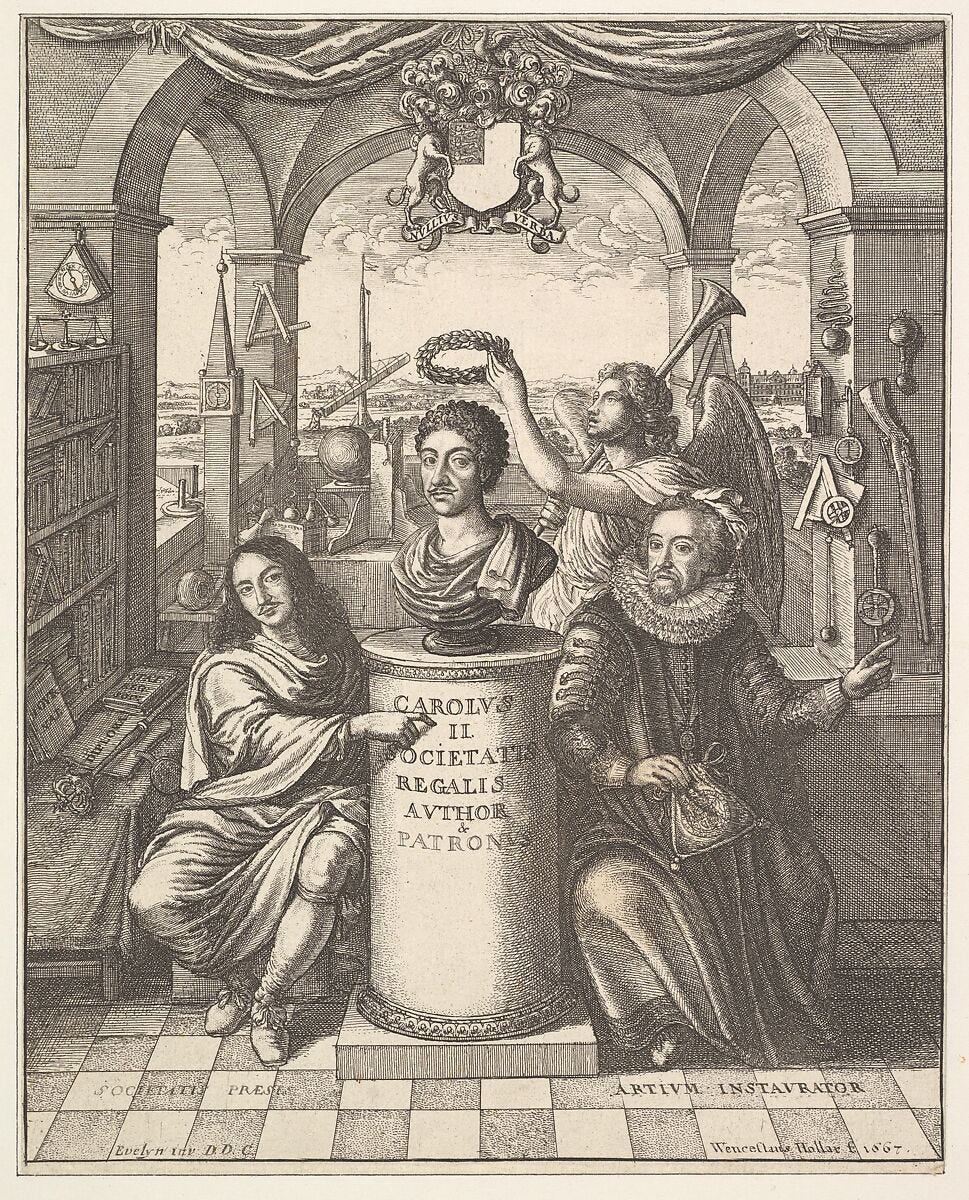
Sprat argued that the old philosophy, practiced by the Greeks and their admirers, produced knowledge that was “a Shipwrack in the end of the Voyage.” Their knowledge wrecks just within sight of use.
Sprat’s preferred metaphor is a shore of death rather than a valley, which makes sense for a society that has just taken to the seas. Yet we find the same implied directionality of a voyage and the requirement for explanations of failures to arrive.
“The nature of things betrays itself more readily under the vexations of art than in its natural freedom.” - Francis Bacon, Novum Organum (1620)
The Society believed that experimental philosophy could find useful knowledge through observing phenomena in the world, and dreamed of building encyclopedias of such knowledge. In the early years of the Society, the mad lads actually tried this.
The History of Trades was to be a comprehensive account of all the techniques, tools, and secrets employed by craftsmen throughout England. The workings of the entire economy in one convenient place. One of organized science’s first Grand Challenges.
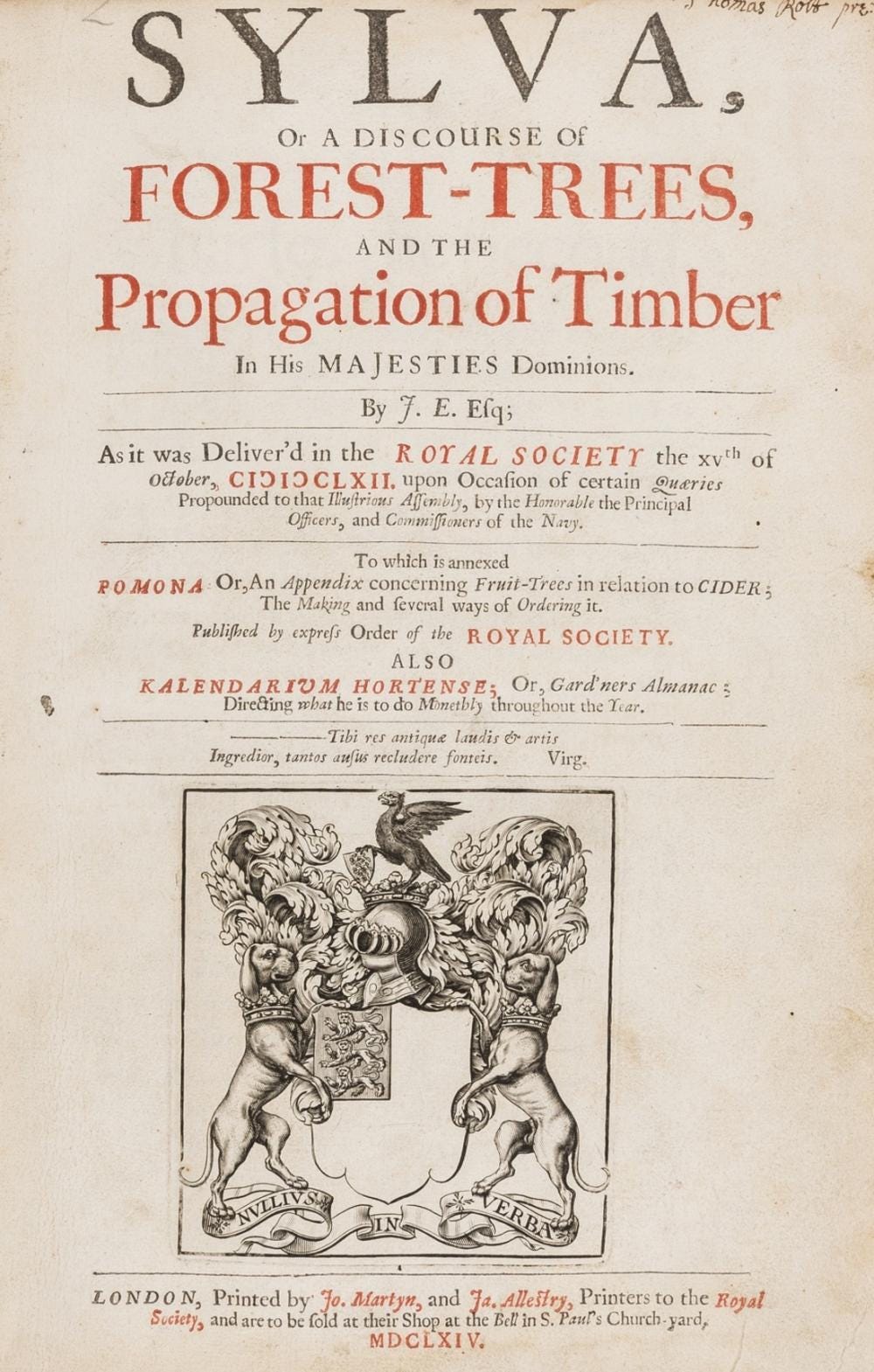
Not everyone felt happy about visiting the workshops where this knowledge lived. John Evelyn attempted to inventory roughly three hundred subjects, from brewing and dyeing to glassmaking, engraving, and wire-drawing.
In 1659, he admitted to Robert Boyle:
“In the History of Trades, I am not advanced a step; finding (to my infinite grief) my great imperfections for the attempt, and the many subjections, which I cannot support, of conversing with mechanical capricious persons.” - John Evelyn to Robert Boyle in 1659
Translation: the scope is absurd, the company is worse.
Boyle, a bit wordily, viewed this reluctance to enter the workshop with contempt. The craftsmen might actually observe more diligently than the philosophers for the simple reason that their livelihoods depended on it.
“The phaenomena afforded by trades, are a part of the history of nature, and therefore may both challenge the naturalist’s curiosity and add to his knowledge, Nor will it suffice to justify learned men in the neglect and contempt of this part of natural history, that the men, from whom it must be learned, are illiterate mechanicks... is indeed childish, and too unworthy of a philosopher, to be worthy of an honest answer.” - Robert Boyle, The Naturalist’s Insight into Trades (1671)
Or William Petty, the son of a cloth-maker, who spent his boyhood watching smiths, watchmakers, carpenters, and joiners, and could see something the others couldn’t. He wanted techniques collected so that they could migrate between the trades. Improvement in one practice might unlock improvements in others.
What had they produced that was answerable to their mighty hopes?
Histories of gunpowder and dyeing. Reports on glass, metals, brewing and other trades. Questionnaires, correspondences, specimens, and notebooks. Many, many notebooks. One of Evelyn’s surviving ones, Trades: Seacrets & Receipts Mechanical as they came casually to hand, is 600 largely empty pages, containing headings with nothing underneath them. I’ve been there.
These are all fragments of the totalizing vision. And for all the typical reasons: the scale was too large, personnel (the virtuosi) weren’t sufficiently committed, trade secrets stood in the way, and the part of the project imagined as easy—making tacit knowledge intelligible—turned out to be the hardest thing.
Their mighty hopes gave way to what reality permits. Fragments of an idea jumping ship to arrive at shore.
A thousand valleys for every dream
We are still better at envisioning the totalizing future than the particulars of how. This will change everything.
Has 3-D printing crossed the valley? Yes and no. Judged by its mighty hopes, it’s a spectacularly successful failure.
“Automated fabrication will take its place among the major industrial developments of the 20th century.” - John P. McTague, a Vice President at Ford, in the foreword to Marshall Burns’s Automated Fabrication (1993)
Burn’s believed its impacts would be larger than the computer revolution. 3-D printing would put a factory in every home and collapse global supply chains. Obama partly agreed.
“3D printing has the potential to revolutionize the way we make almost everything.” -President Barack Obama, State of the Union Address, 2013
Chris Anderson thought, while writing at Wired in 2012, that kids today will grow up thinking that making stuff is as simple as publishing a blog.
That future hasn’t arrived and there are good reasons why it may never arrive. And yet, 3-D printing is remarkably successful. Want a rough and dirty prototype of an end-effector for your robot? Print one. Recently got a new dental crown? It may very well be 3-D printed. The iPhone Air and Duo use printed parts. It can have enormous advantages over milling in weight, time, and customization. Yet in aerospace and other industries where structural integrity matters a whole lot, these parts still have to prove themselves to regulators. Variations in powder, machines, and post-processing must produce the same inspectable, flightworthy part every time.
It’s succeeded where peculiar advantages outweigh peculiar limitations. It shed destinies until it found uses.
Maybe it’s more useful to think of the singular valley as many plural ditches. The tacit-to-formal one Evelyn drove into. The combinatorial ditch of our watcher on the steppe. The scale ditch. The diffuse-financial-capture ditch. The regulatory ditch. The society-has-a-vote ditch.
We hide different causal mechanisms beneath a shared story. What is actually happening and what, if anything, can be done about it?
Our heroic narrative turns an ordinary process of technological pruning into a story of success deferred. And what happens to a success deferred? Does it dry up? Does it fester like a sore? Or explode? Perhaps.
Many times, the idea is simply bad. That’s okay.
But grandiosity should belong to the pursuit of knowledge, not stunted ideas. Yet we are uncomfortable paying for poetry, so we insist on paying for prototypes.