



Thought experiment. A medical-components manufacturer is chasing hairline cracks in an injection-molded housing. It’s cycled through resin suppliers, adjusted cooling cycles, and increased injection pressure.
The manufacturer has tried everything it knows to try, so it calls in two outside advisers. They arrive with access to the same AI.
The first asks the company what it needs. Writes down “assistance with injection-molding defects.” Queries the literature. Identifies several plausible specialists, including one at a university fifty miles away. Knows someone there, it turns out. Mentions they’ve just gotten new microscopy equipment. Offers to make an intro. Finds some outside funding that might be available for an assessment.
This is useful, but the search space is enormous.
The second adviser has worked with the company on other projects for the last fifteen years, including on one previous attempt to fix this process. They know its machines, its people, and its customer’s requirements.
They start probing, and, in their probing, compress the search space.
Didn’t you recently change your material handling process? Huh, that’s weird, these cracks are mostly appearing near one weld line. Whoa, who do you have running the dryer on the night shift? Defects rise 20% then.
They ask the AI what could cause delayed cracking near a weld line in this particular polymer after sterilization, given inconsistent pre-molding moisture levels, the pressure limits of the company’s machine, and the results of previous experiments.
Maybe neither adviser solves the problem. But which one is more likely to?
Coming abundance and bottlenecks
The recent White House OSTP report, A New Golden Age, sets an ambitious goal of doubling the productivity and impact of American science within a decade. The report correctly describes discovery as an iterative loop in which academia, industry, engineering, and manufacturing all play a role in shaping research questions and discoveries. Adding AI will, the report argues, accelerate that loop.
“Meeting this moment requires revitalizing the web of skills, suppliers, and tacit knowledge that form America’s industrial commons, and cultivating vibrant communities of scientists, researchers, and craftspeople in a hundred Silicon Valleys across the nation.”
From A New Golden Age
This raises a question: what must exist inside, or immediately around, a company for that loop to work?
There are already good summaries of AI takeoff and diffusion constraints, see Cowen’s. As it relates to institutions becoming the bottleneck, there are at least three different problems.
The first is a throughput bottleneck. Drug candidates are generated faster than regulators, clinical trials, or factories can process them.
The second is a jagged frontier bottleneck. Some sciences accelerate faster than others, but the slow movers are on the critical path for overall progress.
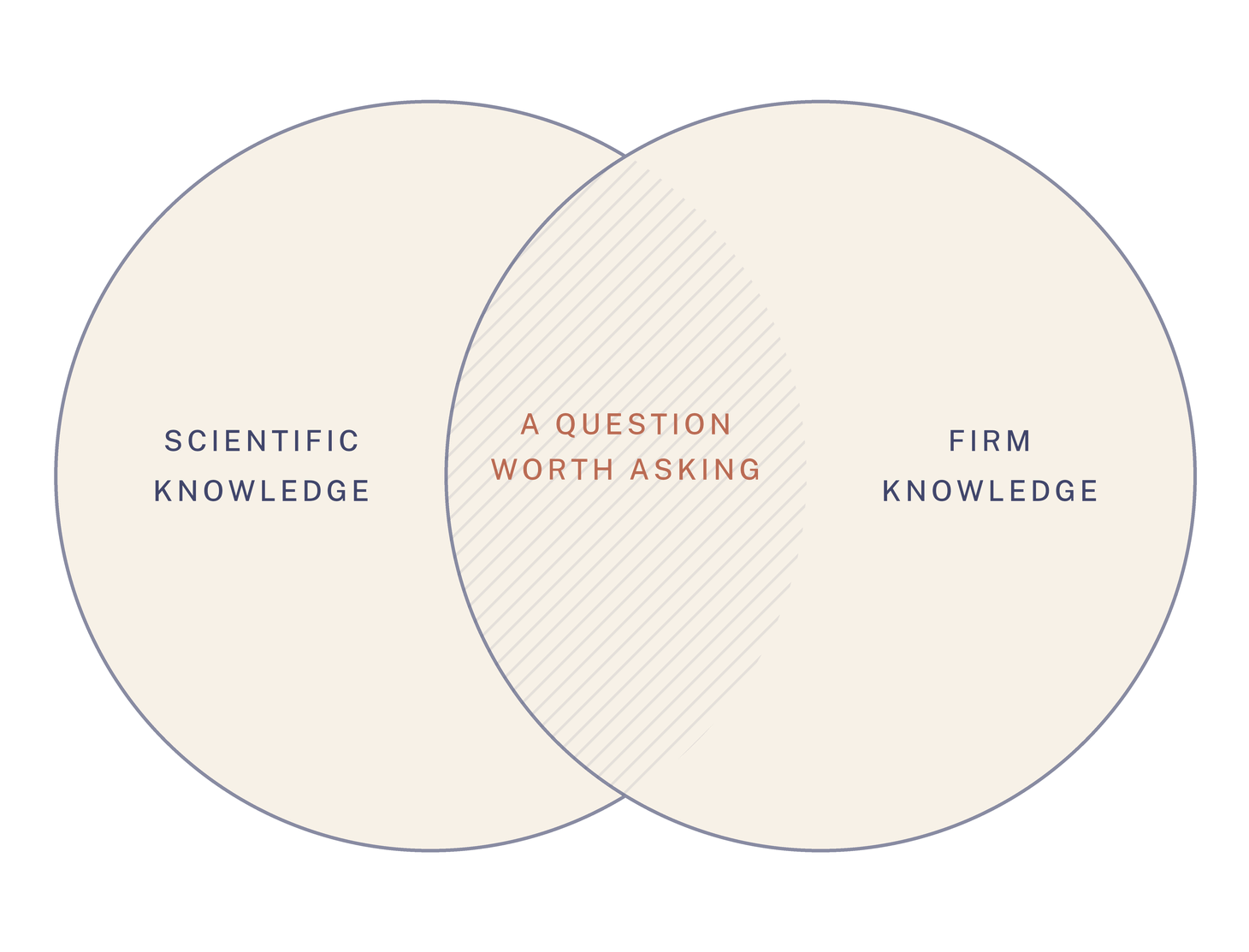
The third, and subject of this post, is an absorption bottleneck. Useful knowledge exists, but firms cannot recognize what matters, relate it to their particular circumstances, and make use of it.
This concept is borrowed from Cohen and Levinthal. Each organization has a variable ability to see the value of external knowledge, assimilate it, and apply it commercially. This variable is called absorptive capacity. A firm needs internal expertise to understand external expertise, so internal R&D has value because it both produces new firm-specific knowledge and allows the firm to benefit from knowledge produced elsewhere.
There’s also an interactive model of absorptive capacity built with network science. Explore Can the Firm Hear It?
A manufacturer can be located inside a research cluster. A scientist can rotate into industry for six months. Neither means that the company will recognize which discoveries matter or connect them to its own problems.
This is already true without AI. But dramatically expanding the search space compounds the challenge of navigating it. A small manufacturer will not read ten times as much science simply because ten times as much is being generated. Its attention and knowledge of its own systems have not increased at the same rate.
This is especially true if the manufacturer is reading no science at all.
Variety and where firms once kept their attenuators
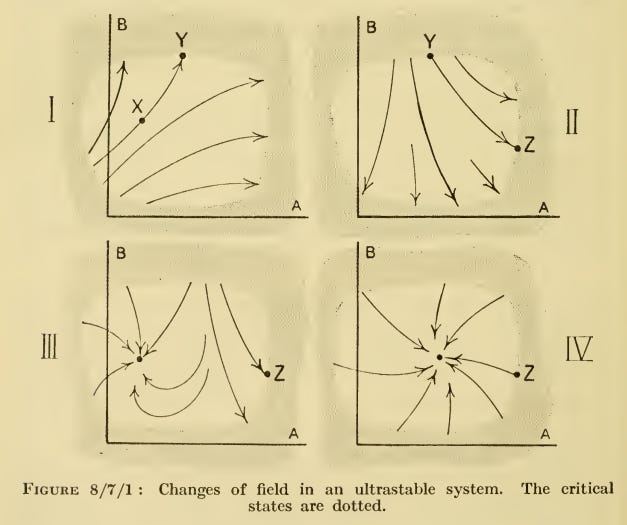
Let’s borrow Ashby’s Law of Requisite Variety here. A system, in our case a manufacturer, can only respond effectively to its environment if it possesses as much variety as the environment. In this push and pull, amplifiers increase the variety available to a system, while attenuators reduce it to something that can be managed.
Our wicked smart AI might become a fantastic variety amplifier, but where are the attenuators? Maybe it’s also AI, but it still needs firm-specific knowledge to navigate the search space.
There’s a tendency to treat the heyday of corporate labs as solely a story of a time when firms created small internal universities and produced new science (see my article below).

But these internal universities were also sensory organs and variety attenuators. Their scientists followed external research, translated it into company problems, and created technically capable counterparts for the broader scientific community to communicate with. This expanded the range of scientific signals the company could perceive and use. Beginning in the 1980s, large American firms have steadily withdrawn from science as corporate R&D has shifted toward developing and commercializing existing knowledge.
The machinery for producing science travels with the machinery for absorbing it. Most small companies never built the machine.
Back at the farm
All of this is a bit too ones and zeros. How about a pastoral palate cleanser?
At the beginning of the twentieth century, the boll weevil took a road trip across the American South, destroying cotton crops as it went. The federal government had developed control methods, but a leaflet from Washington was unlikely to get farmers to actually use it. Why trust someone who has never worked your land?

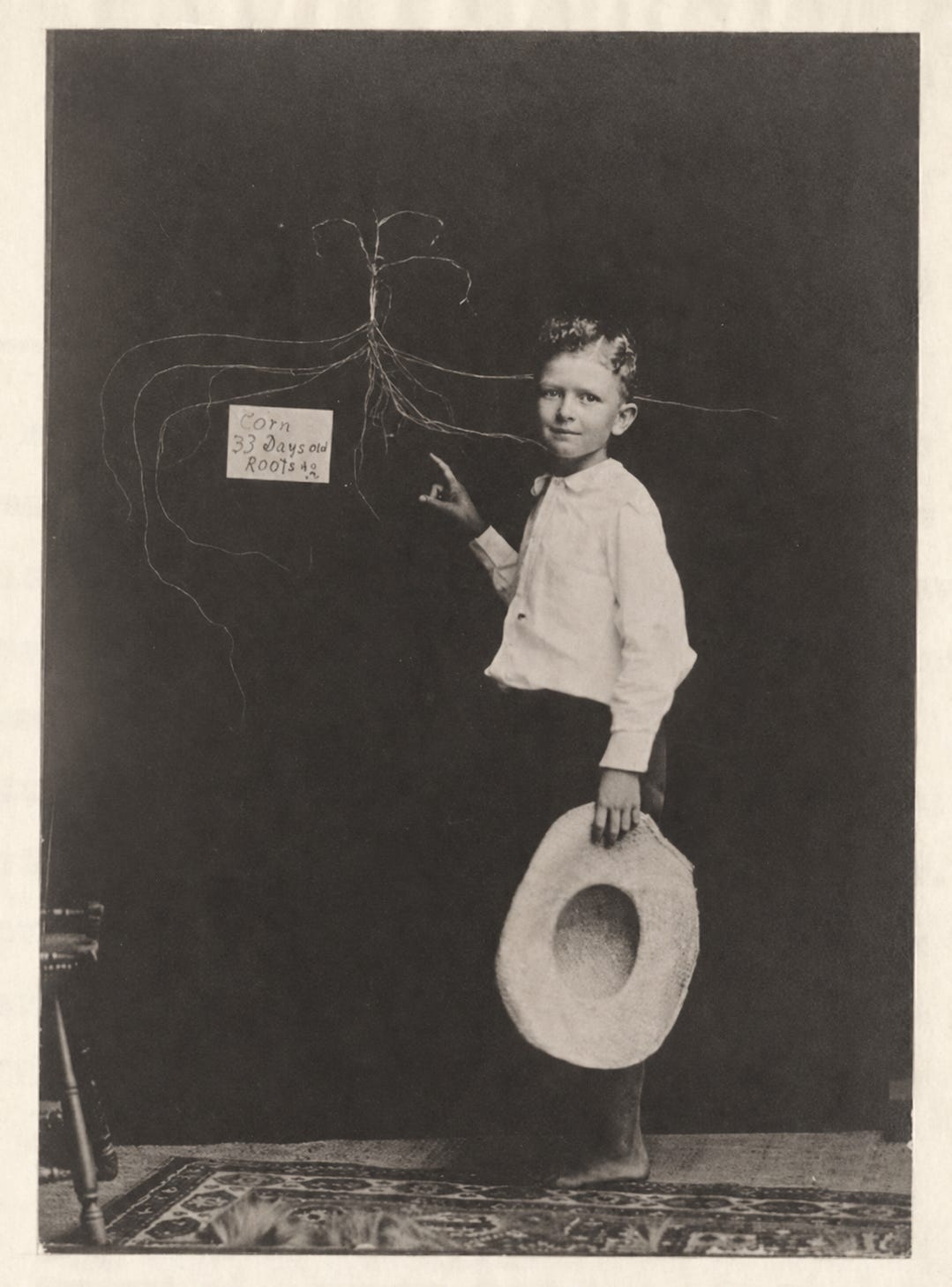
So Seaman Knapp, a USDA official, tried something different. He arranged for farmers to test new cotton varieties and cultivation methods on a Texas farm. He let them see how these new methods performed under conditions resembling their own. Knapp’s been quoted as saying, “what a man hears, he may doubt; what he sees, he may possibly doubt; but what he does himself, he cannot doubt.”
The demonstrations spread throughout the 1900s and 10s through county agents. Agricultural journals existed. Experiment stations produced research. Colleges trained experts. But the Cooperative Extensions founded through the Smith-Lever Act of 1914 built a chain long enough for all of this to reach the farm.
A farmer could not be expected to personally follow developments in all the sciences relevant to their farm. Through the county agent, they could externalize absorptive capacity. The agent lived near the farmers, understood local conditions, and could reach back into a larger network of specialists and experiment stations when necessary. The problems farmers encountered could travel back toward researchers, too. This connected two bodies of knowledge: agricultural science and farm-specific.
On the shop floor
Land-grant universities were originally created for both agriculture and the mechanic arts. Why did only one side acquire an extension system of comparable reach and permanence?
Part of the answer is that the need to externalize absorptive capacity is easier to see on the farm. They’re numerous, dispersed, and it’s a bit absurd to expect they’ll employ their own soil chemists, plant pathologists, and entomologists. Local similarity of soils, pests, and weather makes a territorial system more plausible.
Manufacturing is jagged. The same region might contain a foundry, a machine shop, a food processor, a chemical plant, and an electronics manufacturer. Each working with different equipment and materials, drawing on different bodies of technical knowledge. An industrial county agent would either have to remain a generalist or have access to a much larger network of specialists.
At the time these things were debated, it wasn’t clear that American manufacturers couldn’t look after themselves. This was the era of GE, DuPont, Bell, Kodak…, all maintaining their own labs. Smaller firms could just obtain whatever knowledge they needed from a network of equipment suppliers, customers, and consultants.
This type of government support also looks like a subsidy to private companies or public competition with consultants who sell the same service. But if we’re renegotiating science and industrial policy, maybe that debate needs to be reopened?
In 1965, America briefly attempted something resembling an industrial Smith–Lever Act. The program began developing field services through universities and state institutions. It lasted five years.
One of the early experiments that preceded the legislation was done in 1964. NASA funded a Technology Use Studies Center at a small college in southeastern Oklahoma. It connected NASA’s vast scientific and technical information system to manufacturers across seventeen mostly rural counties.
Reading the report, it becomes clear that the challenge for manufacturers was more formulating technical questions and less access to technical information. Firms with limited engineering capabilities required an “interpretive step” between research and use. A specialist had to define sophisticated knowledge in terms of the client’s particular problem.

The U.S. tried to create an extension service again in 1988, partly due to rising anxiety about American manufacturing’s decline relative to Japan. This produced the Manufacturing Extension Partnership (MEP), with centers still operating in every state plus Puerto Rico. They help small and medium-sized manufacturers improve quality, introduce automation, train workers, adopt lean, comply with new standards, and locate outside expertise.
That can be very valuable in the same way our first adviser was valuable. But MEP was not built like agricultural extension. Its centers are heterogeneous public-private organizations rather than the local arms of a common research system. Half of their funding comes from nonfederal sources, and they’re evaluated through the attributable results of client projects.
These incentives favor a particular kind of intermediary and a particular kind of problem solving. A manufacturer arrives with an issue. The center scopes a service, provides it directly or locates someone who can, records the resulting cost savings or new sales, and moves on to the next project.
Some MEPs have in-house engineering capabilities, others operate as consultancies and network brokers. The system, though, does not require every center to maintain laboratories, conduct research, or accumulate technical knowledge of local firms.
This may be changing. A new NIST competition for fourteen MEP centers placed greater emphasis on helping manufacturers demonstrate, deploy, and adopt advanced technologies. This could pull them toward deeper technical capabilities.
Broadening the aperture
Ok, we’ve tried some experiments. Maybe this particular externalized absorptive capacity institution is just not possible for manufacturing. Let’s broaden the aperture a bit.
Since the early twentieth century, Japanese prefectures have had public industrial research and testing centers known collectively as kohsetsushi. Initially, they served agriculture and other regional industries, but gradually extended to manufacturing.
The centers collectively employ thousands of engineers and researchers. They maintain testing equipment and laboratories, provide technical consultation and training, conduct applied research, and sometimes develop inventions that local firms can license. A small manufacturer that cannot employ a specialist can temporarily reach one via a center nearby. And because they’re a steady local presence, trust accumulates between the actors.
They’re proof that absorptive capacity can sit outside the firm, while still accumulating firm-specific knowledge.
The English-language literature on kohsetsushi is a bit thin. Philip Shapira produced an account in the 90s and, more recently, Nobuya Fukugawa has assembled empirical evidence on how the centers solve problems and learn about local technical needs.
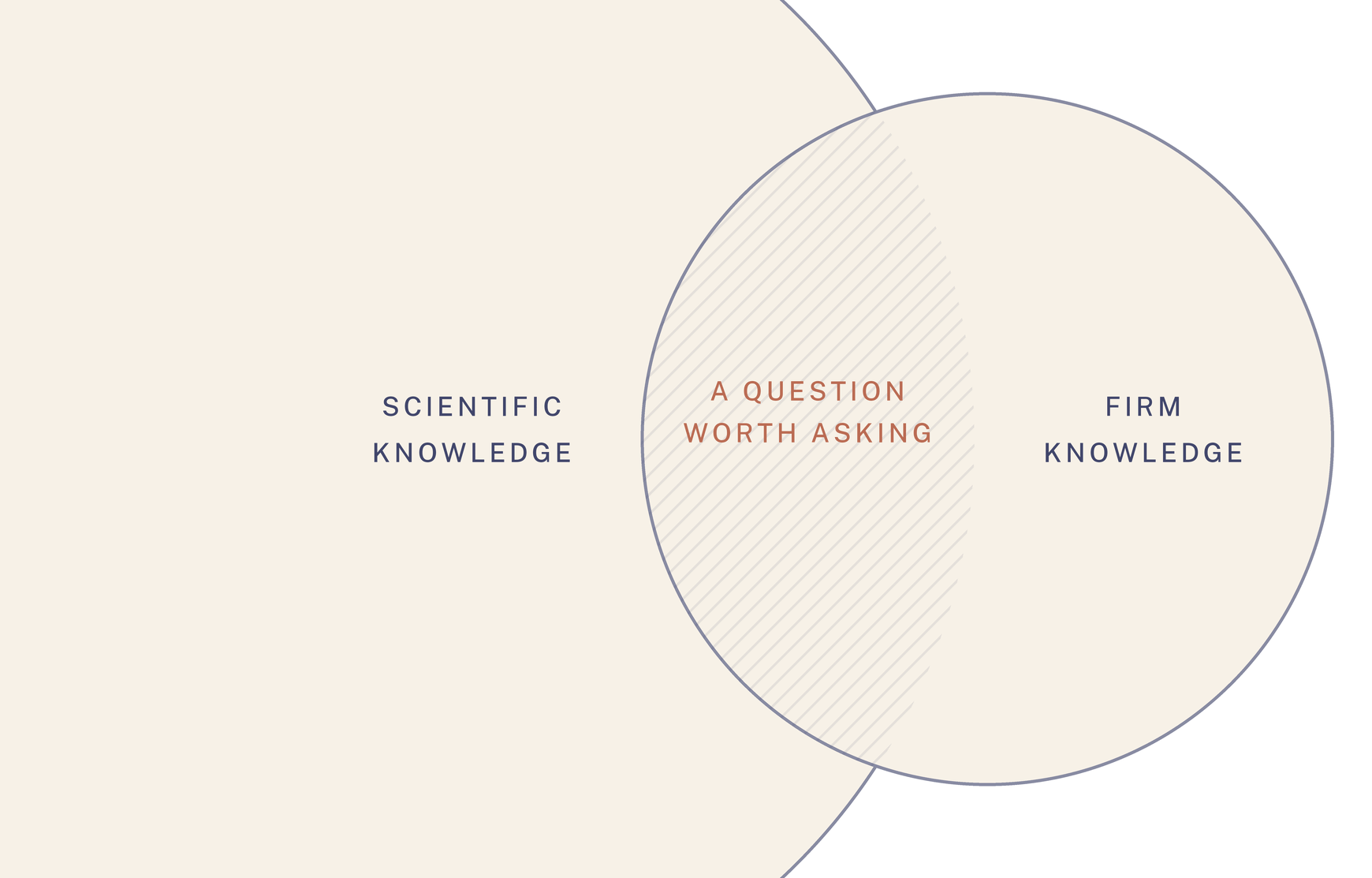
Kohsetsushi sometimes make referrals and MEPs sometimes contribute to deep technical work. But the center of gravity is different. The kohsetsushi can occupy the overlap between two bodies of knowledge: the evolving technical frontier and the accumulated problem histories of local firms.
Back to our two advisers. AI should make both of them better. The first will search a larger literature, identify specialists more quickly, and make better referrals.
But the second adviser can relate what science knows generally to what has happened inside this factory specifically.
Scientific abundance amplifies that difference. The more possible explanations, the more important it is to know which possibilities can be discarded. At least in the near-term, the value of situated knowledge may increase disproportionately.
This doesn’t mean America should reproduce kohsetsushi or that MEPs couldn’t take on this work. But absorptive capacity has to exist somewhere. Large firms may maintain it internally. Small firms may still depend on a network of institutions that already exist or ones we have yet to build.
Someone still has to know the factory.