


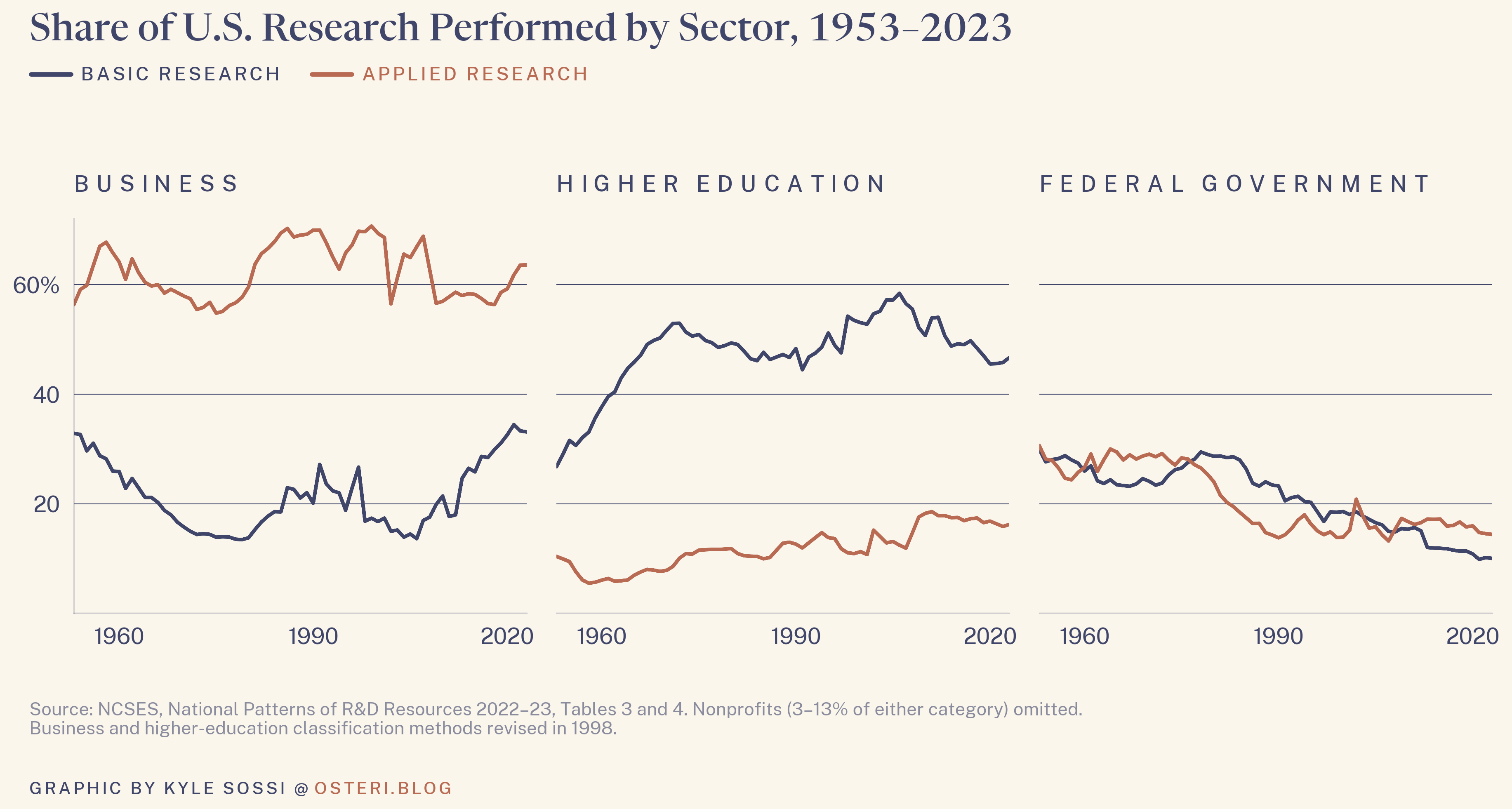
If you spend weekends looking at US R&D data, one of the surprising things you’ll notice is that there’s been an explosion in businesses performing “basic research” over the past ten years. By 2023, we were at a level approximately on par with 1953, before much of the federal spending for R&D started.
Basic research is itself an odd category. Jane Calvert’s 2006 paper “What’s Special about Basic Research?”, remains a great primer on its slipperiness. She interviewed scientists and policymakers about how they defined and used the term, and found their answers were often context dependent.
One biologist, when speaking with the more business-minded, would drop the word basic early on in the conversation. This signaled that the suit shouldn’t expect anything patentable or profitable. They quickly lost interest. Others would do the reverse, talking up the industrial relevance to be more competitive for funding, even if the underlying work was essentially the same.
This slipperiness makes the term useful for establishing boundaries and expectations, deferring certain types of evaluation, and preserving the image of the scientist as an independent truth seeker.
There are economic explanations for why a business would conduct exploratory, long-horizon research that we would normally classify as “basic” (see Nelson, 1959; see Rosenberg, 1990; and see Cohen and Levinthal, 1989).
These tell us why businesses might do research. But how and why do they make a big show of it?
Let’s break it down into three main categories: shows of force, access tokens, and crystal balls. Scientific companies have to show that they’re capable, that they legitimately belong within science, and that they can be trusted as guides to the future. These are all claims about the type of company they are.
Shows of Force or We’re really really good at this.
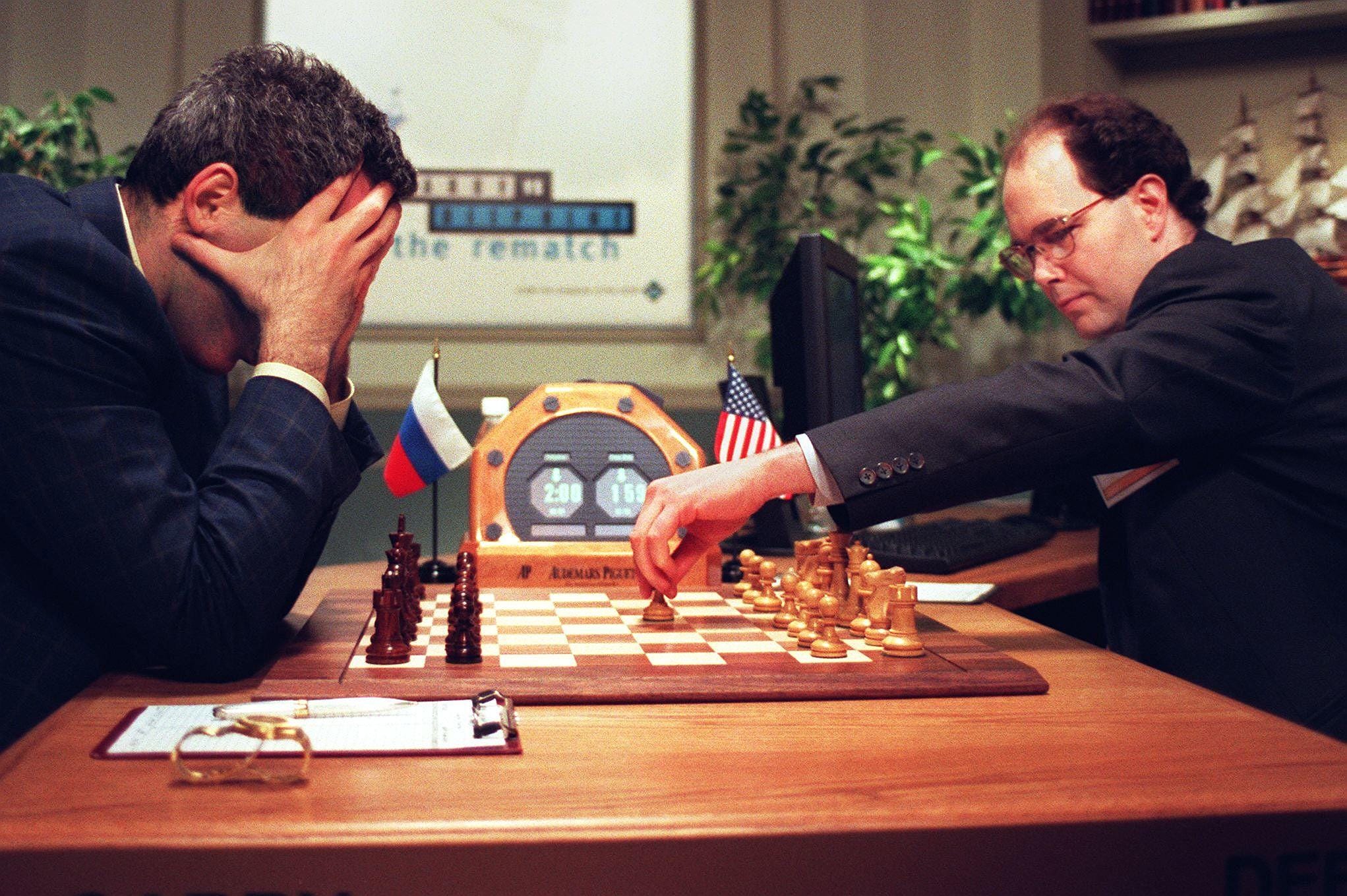
In this bucket are your Deep Blues, Watsons, and AlphaGos. These take a nebulous, difficult-to-evaluate technical capability and place it inside a public spectacle that is easy to understand.
Chess is hard. Grandmasters are good at the hard thing. The computer beating a grandmaster is impressive. That’s all there is to it.
These can be contests, where the rules are understandable, or heroic triumphs over the limits of nature.
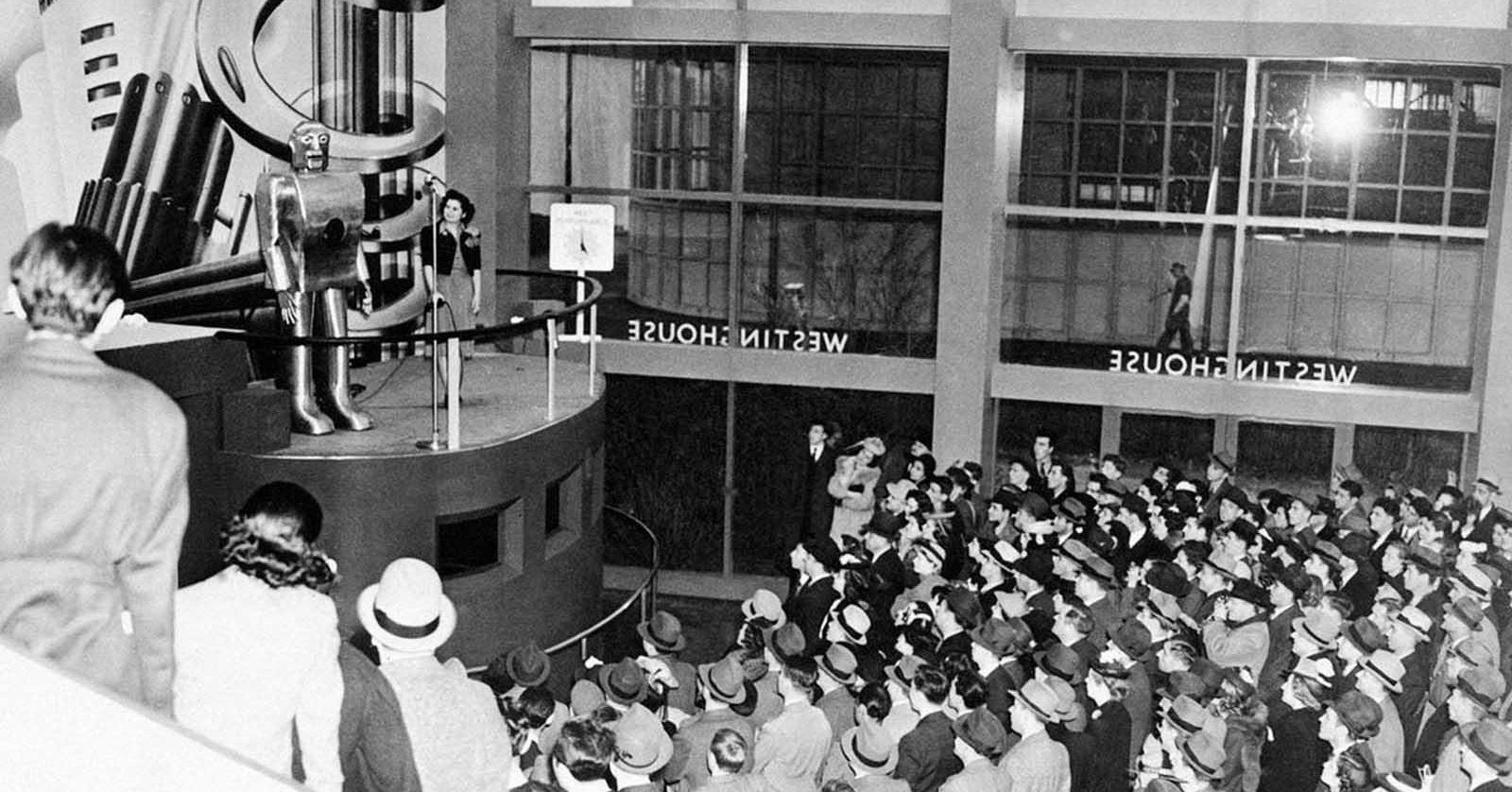
At the 1964 World’s Fair, IBM had a machine that transferred Russian text over telephone lines to a computer ninety miles away and returned it as English. People couldn’t believe it and accused IBM of using a Mechanical Turk.
The first transcontinental telephone call was a staged spectacle. Alexander Graham Bell was in New York and Thomas Watson was in San Francisco. Bell repeated the same words from the first telephone call, which covered just two miles: Mr. Watson, come here. I want you. Watson replied that it would now take a week. President Woodrow Wilson and the mayors of the respective cities were wired in on the group call. Nothing to add from my end, thanks!
Nixon called Neil and Buzz on the moon. AT&T is partly to thank for giving us this quote.
“Because of what you have done, the heavens have become a part of man’s world.”
President Nixon to Neil Armstrong and Buzz Aldrin, July 20, 1969
These events work because of compression. They take years of research and enormously complex technical systems and make them publicly understandable. Someone speaks; someone impossibly, unfathomably far away answers.
They invoke wonder in the capabilities of those companies. And become entwined in the stories those companies tell about themselves. Move 37 is a landmark in AI research and a naming convention for Google real estate.
Access Tokens or We belong here.
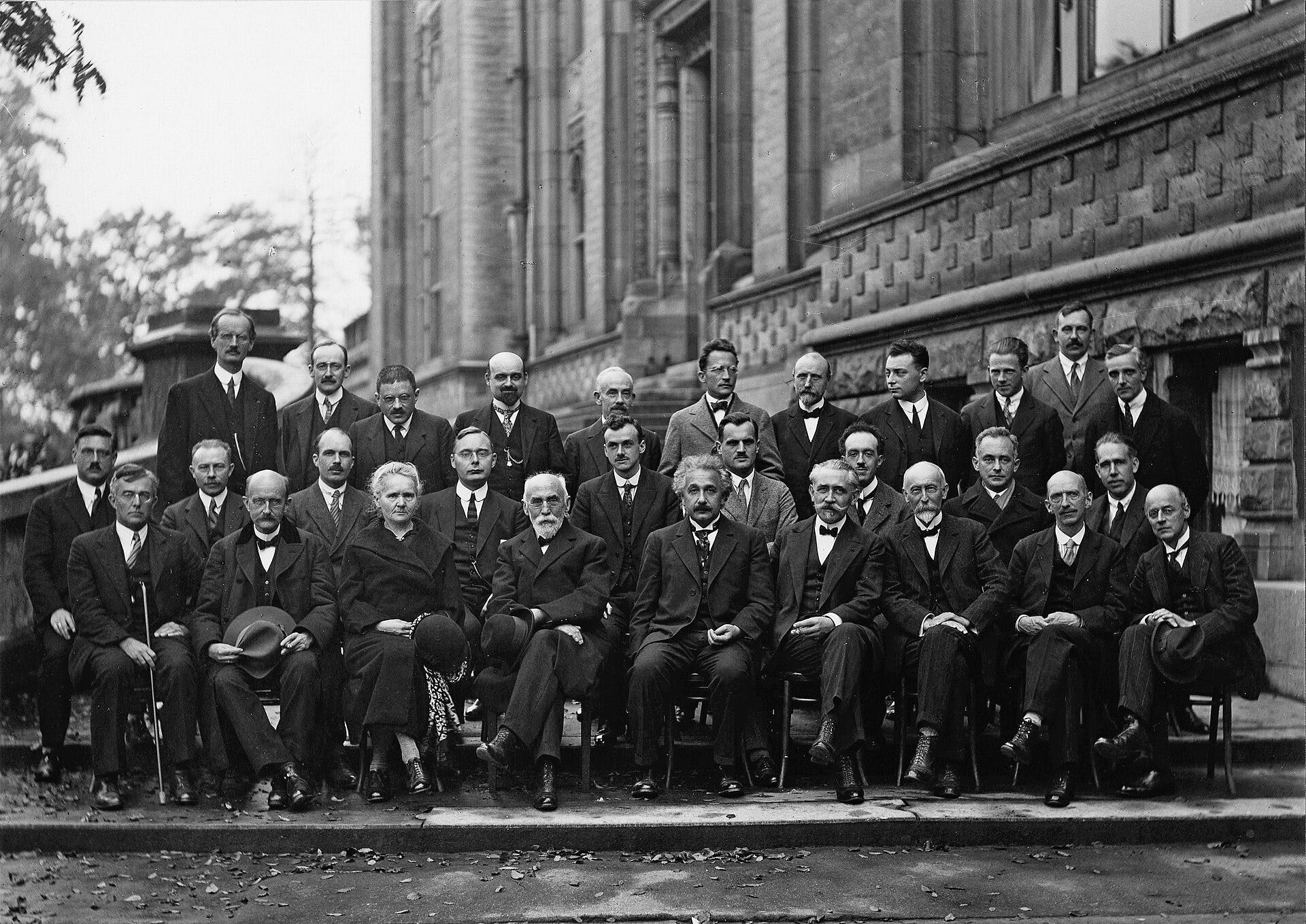
Scientific knowledge is sometimes imagined as a static object. It sits on a shelf in a library or journal somewhere, freely available to anyone capable of reading it. Like any human endeavor, though, scientific knowledge is partly social. It moves in conferences, collaborations, and informal conversations between people who are engaged in interesting work and know who else is.
To access that layer of knowledge, you have to earn your place as a genuine and trusted participant in the network.
Publishing is one way of buying an access token. New papers contribute knowledge to the community, which is a genuine public good. It signals that in this company, we believe in science. It’s also reciprocal participation in a knowledge system: I disclose some of what I know to learn some of what you know.
For the scientists, publishing papers, presenting at conferences, and collaborating with colleagues allows them to remain recognizable as a scientist. Giving them freedom tells other researchers that you can work here without ceasing to be a scientist. This pitch is surprisingly powerful. Scott Stern found that scientists were willing to trade some salary for jobs that allowed them to pursue and publish research.
Access tokens work through reciprocity. The company makes some knowledge public and, in return, gains access. Papers appear, doors open. The identity of scientists is recognized, the company gains talented people.
I explore the norms of science in businesses in much more depth in this essay:

Crystal Balls or We see the future.
The performance of science is also a way of showing strategic foresight. Research becomes evidence that the company not only understands the future but is actively creating it, confidently steering the company into its waters.
Earlier this year, Google announced that it would migrate its systems to post-quantum cryptography by 2029. The company pointed to advances in quantum hardware, error correction, and estimates of the resources required to break existing encryption. A few days later, its researchers published new estimates suggesting that a quantum computer could break widely used elliptic-curve cryptography with roughly twenty times fewer physical qubits than previously estimated. Translation: this is coming faster and cheaper than expected.
The research was a genuine contribution to the field and supported Google’s strategic story. We can see what is coming, and we know what to do about it. The company’s ability to produce scientific knowledge becomes evidence that it can be trusted to make decisions using that knowledge.
These performances often move smoothly between scientific and managerial language. You’ll find them in forward-looking statements, shareholder reports, and the like. Technical results become forecasts, which establish deadlines, which are then decomposed into near-term investments and product strategy.
Crystal balls work by translating ambiguous scientific progress into confidence in corporate judgment. We’re creating the future and plan to be here when it arrives. Trust us with your capital.
Open problem summer
As we watch open problems in mathematics begin to fall, what I find most interesting from a corporate comms standpoint is that these distinctions collapse. A new result can be all of them.
It’s a show of force. You don’t need to understand the underlying mathematics to understand that cracking a problem that has been open for fifty years is impressive. Which is good, because my prompts often look a little like this:
“Hey, what is an eigenvector? And please, speak as you might to a young child. Or a golden retriever.”
It’s an access token. Resolving an open problem is a genuine contribution, allowing the company to be associated with the production of scientific knowledge. It’s a signal that we take science seriously and are interested in supporting it.
“We hope the mathematical community will engage deeply with these results, place them in context, and bring the ideas behind them to life through new research and discovery.”
From OpenAI’s Responsibility statement to the mathematical community
And a crystal ball. The advances are often produced by internal versions of upcoming models. OpenAI reported that the token spend on cracking 10 open problems was about $2,000 at API rates. The scientific contribution becomes evidence about their upcoming products, their capabilities, and their economics. Research and advertisement merge into one thing.
Here’s what I mean.
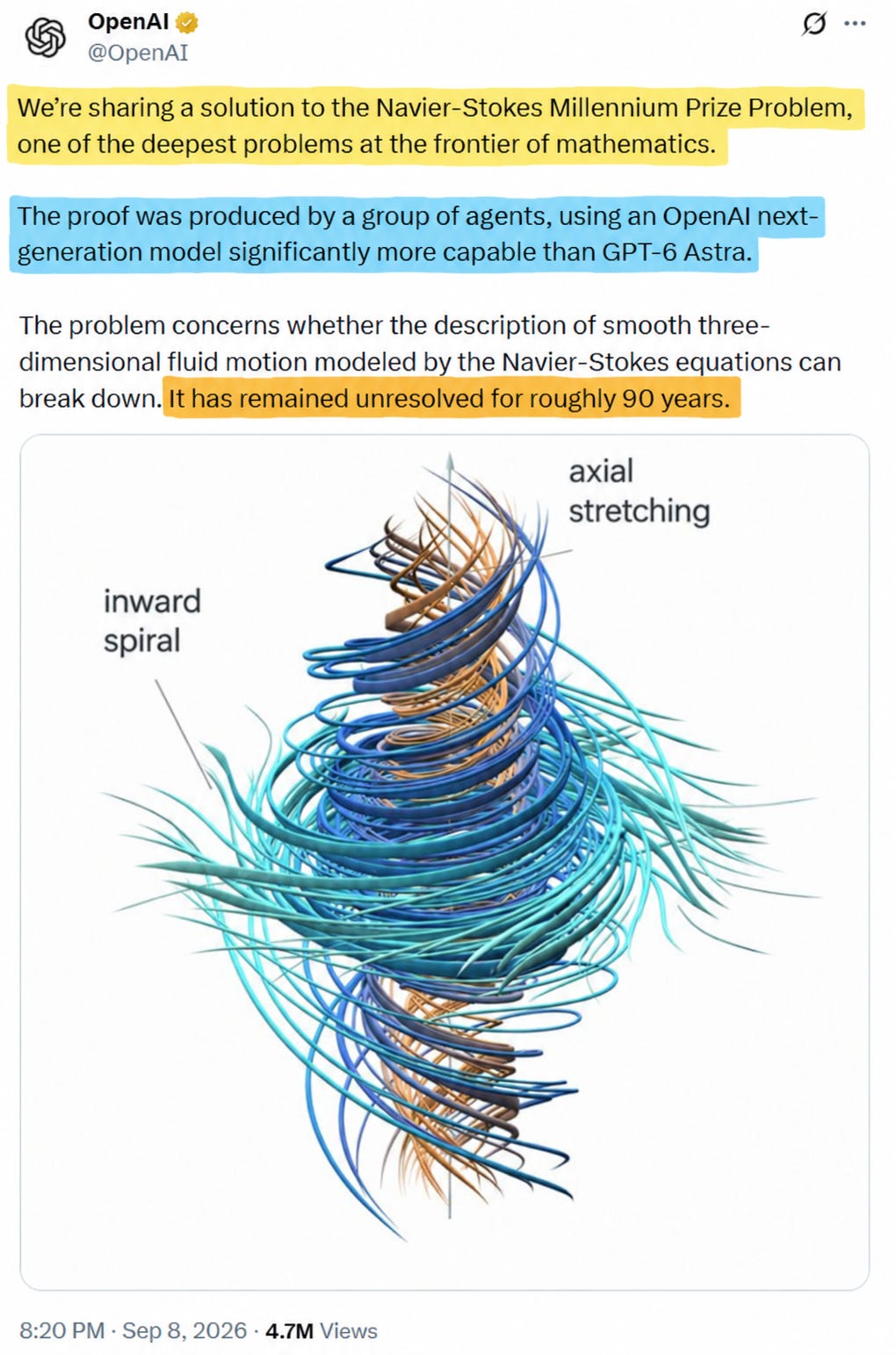
This is from the September 8 announcement by OpenAI where they claimed a solution to a Millennium Prize Problem. This is one of seven problems established in 2000 to organize the field. It is the second to be solved after the Poincaré conjecture. There’s active discussion on the validity of all this, which I’ll leave to the mathematicians to sort out. Fittingly, much of the dispute is over who gets credit for the knowledge and whether the field recognizes this contribution as legitimate.
Even stranger, perhaps, is that this isn’t always centrally staged. Models are released into the wild and users aim them at problems as weekend projects. Even if they aren’t directly a part of the company, they function as a diffuse extension of the strategy.
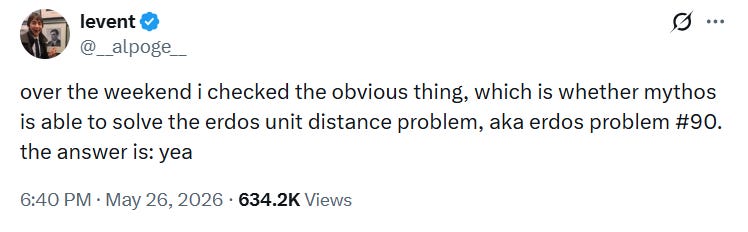
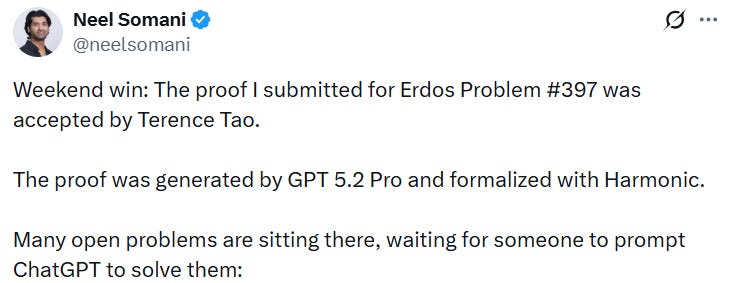
This diffusion is an interesting wrinkle. Stranger still is that companies are beginning to make a different kind of knowledge claim about what their systems do.
AlphaFold was revolutionary, but it was recognizable as a tool scientists could use to pursue scientific questions. Closing open problems produces scientific knowledge that did not previously exist. This renegotiates who or where we expect knowledge claims to come from. The old solution to this problem (insulate a lab, hire real scientists, and let reciprocity work) doesn’t obviously transfer when the knowledge maker isn’t socializable.
Mathematics is beginning to work out what it means to recognize machines as knowledge makers. As capabilities expand, the same question will make its way into other fields with the companies needing to pay the corresponding access tokens.
Less what kind of science is this? More what kind of scientist is this?